Morning, afternoon or evening exercise for sleep? A new meta-analysis
Gym schedules fight with work calendars. If you only have 7 p.m. free, do you harm sleep? A September 2026 Frontiers in Psychology meta-analysis weighs time of day against sleep quality and mood (Hu and Chen, 2026).
In brief
- 13 randomised studies (7 parallel, 6 crossover), 442 participants, 81 effect sizes, 10 countries, years 1992 to 2026.
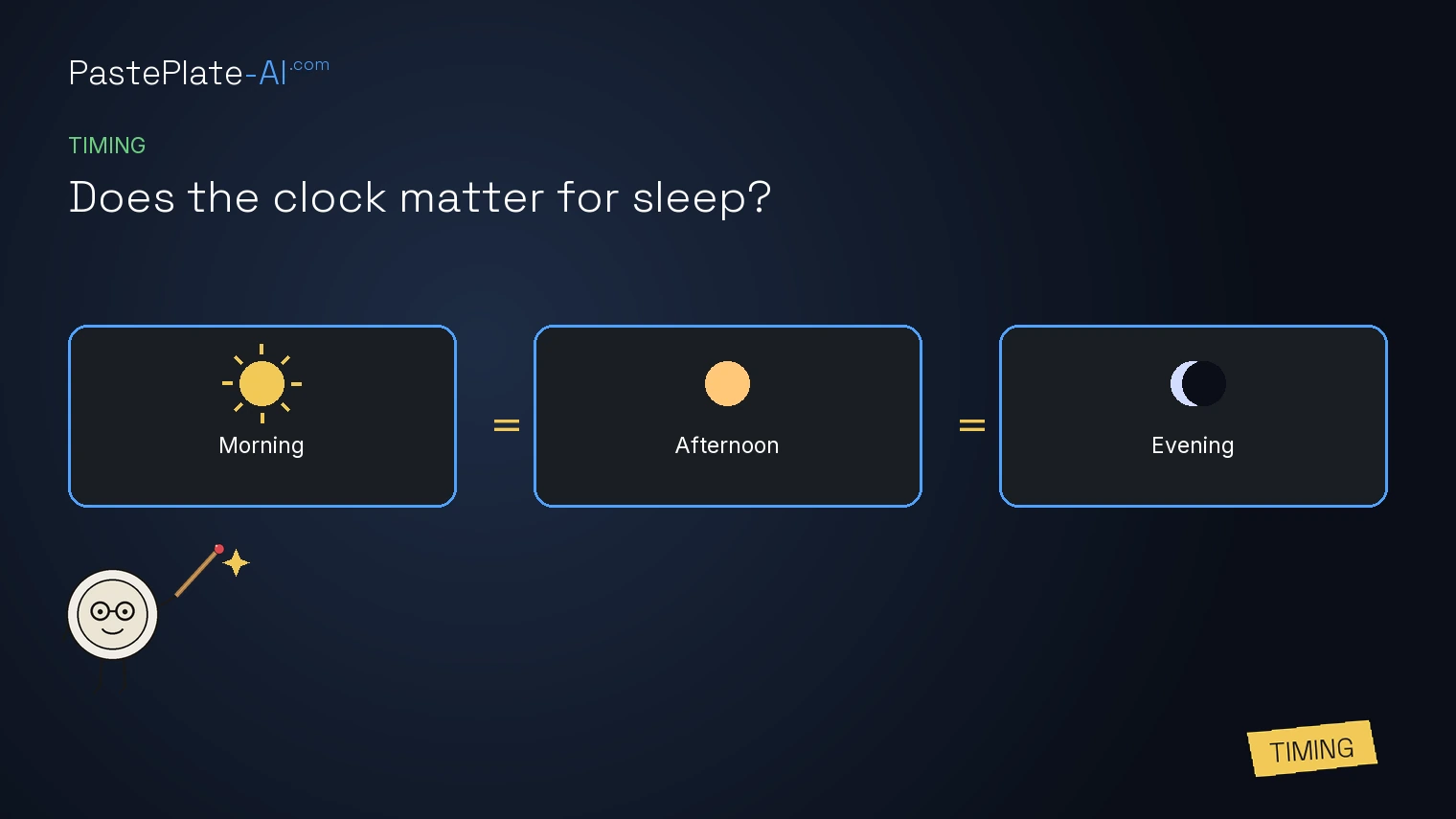
- Time vs time for sleep: no stable advantage for morning, afternoon or evening (pooled g = 0.15, not significant).
- Exercise vs no exercise: large effect in a conventional model (g = 0.86) but not robust in a CR2 sensitivity analysis (3 studies).
- Mood: afternoon vs evening favoured afternoon (g = 0.50) but only 2 studies.
- Evening defined as 17:00 to 21:00, sessions at least 2 hours before bedtime.
- Authors conclude being active is likely more important than when.
Inside the review

Hu and Chen modelled acute and regular exercise separately in parts of the paper. The headline for clock time is flat: your sleep may not care whether you lifted at lunch or after work, within the ranges studied.
Evening sessions specifically

The review's evening bucket still ended two hours before bed. A hard interval finishing at 10:30 p.m. with lights-out at 11:00 was not what they tested.
Exercise vs couch
The large g = 0.86 for exercisers vs inactive controls shrank under robust variance methods. Translation: exercise probably helps sleep on average, but the evidence base is small and noisy. Do not treat 0.86 as a personal promise.
Mood nuance
Afternoon beat evening for mood in a tiny subset. Treat that as hypothesis-generating, not scheduling law.
What you can try
- Keep the slot you can defend weekly.
- If sleep is fragile, experiment with finishing earlier and note your own pattern.
- Cool-down and light matter as much as the stopwatch.

Limits
- Small trials, heterogeneous protocols.
- Mostly healthy adults; shift workers under-represented.
- Sleep questionnaires vs polysomnography mixed across studies.
This post is general information, not medical or dietary advice.
Sources
- Hu X., Chen P. (2026), "Time-of-day effects of acute and regular exercise on sleep quality and mood: a three-level meta-analysis", Frontiers in Psychology, 25 Sep 2026. frontiersin.org
PastePlate-AI on your phone
The logbook stays on your device. You bring the chat AI you already use.
This blog does not give medical advice. Health disclaimer.