Short nap or long nap: what 16 meta-analyses say about nap length
Daytime naps show up in both directions in the research: sharper for a while, or lined up with later disease. An umbrella review asks whether the length is what separates those stories.
In brief
- Du and colleagues pooled 16 meta-analyses (Public Health Reviews, 3 February 2026).
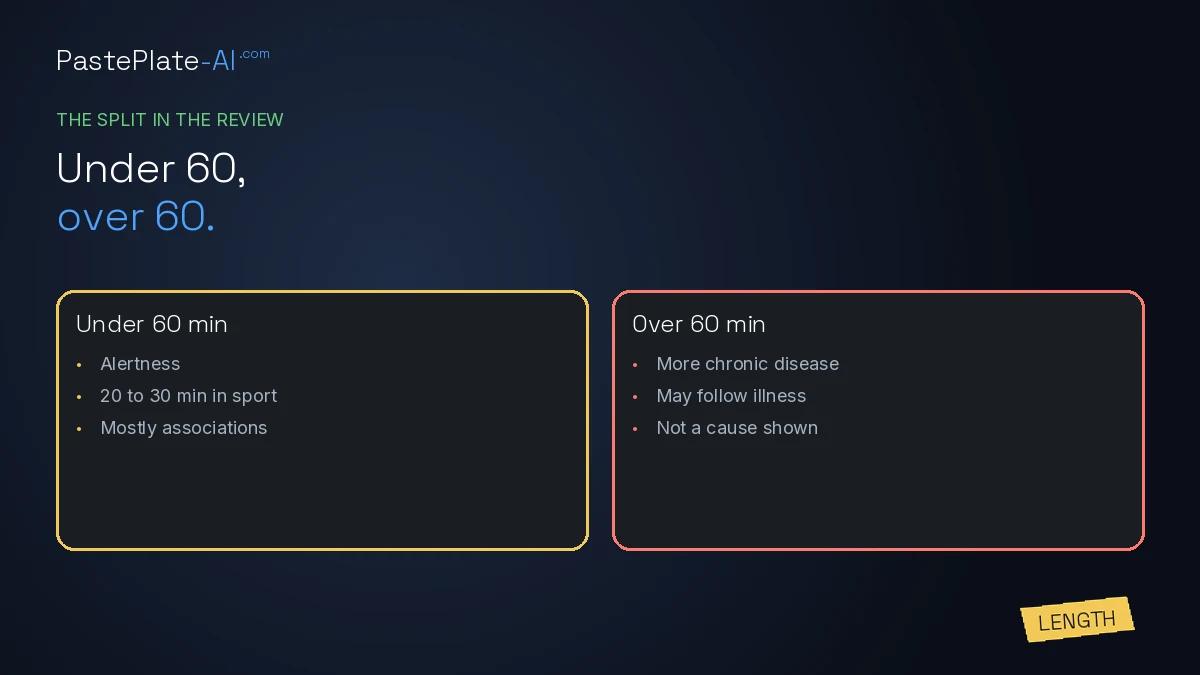
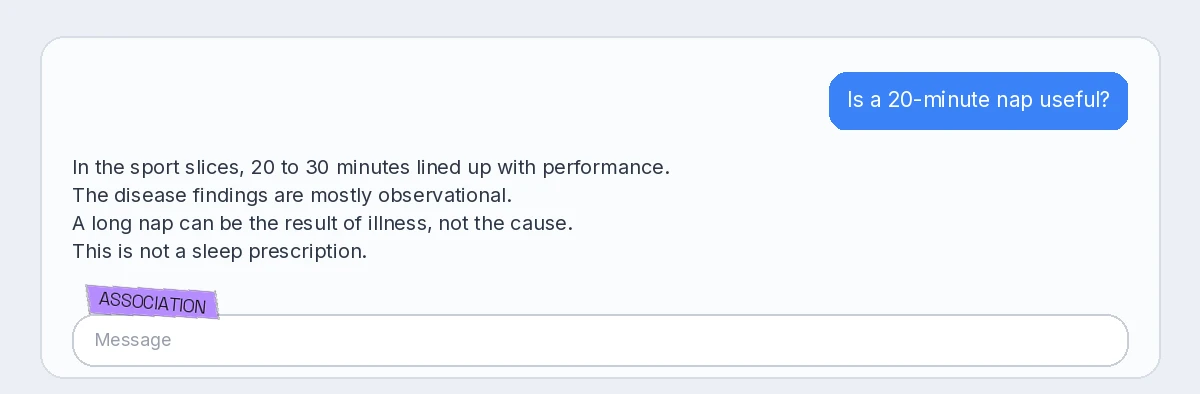
- Naps under 60 minutes were linked with better cognition and less fatigue. In sport settings, 20 to 30 minutes was the slice linked with performance.
- Naps over 60 minutes were linked with higher rates of coronary heart disease (about 30% in that review) and of diabetes and obesity (about 20%).
- Almost all of the underlying reviews are observational. A long nap can be a consequence of illness, not the cause. This is not sleep advice.

What an umbrella review is
An umbrella review does not recruit nappers. It collects meta-analyses that already exist and asks what they share. Du et al. found 16 meta-analyses and 244 outcomes. Fifteen of those meta-analyses were non-randomised. One was of trials. The quality ratings in the review were often low. That belongs next to any percentage.
Short naps and the performance slice
Naps under 60 minutes were the range the review tied to cognitive scores and fatigue. The sport papers inside it pointed at 20 to 30 minutes for performance and recovery, especially when people were short on night sleep. Those sport studies are closer to experiments than the disease papers. They still describe a nap in a protocol, not a rule for every afternoon.
Long naps and chronic disease
The same review linked naps over 60 minutes with higher rates of coronary heart disease, diabetes and obesity. The percentages above are the review's summary, not a personal risk. Long naps are common in people who are already ill, depressed, or sleeping badly at night. Reverse causation is the obvious alternative: the illness may come first, and the nap follows. The review cannot settle that.
A September 2026 paper in the American Journal of Lifestyle Medicine (doi) describes a similar split around 30 minutes in Mediterranean countries. This page uses it only as that pattern, not as a second set of percentages.
What this page will not do
It will not tell you to nap, or to stop napping. Night sleep, shift work, age and illness change what a nap means. If a clinician is already treating a sleep problem, that plan outranks a review.

This post is general information, not medical or dietary advice.
Sources
- Du P. et al. (2026), daytime napping and health outcomes, umbrella review of meta-analyses, Public Health Reviews. doi.org
- American Journal of Lifestyle Medicine (11 September 2026), nap length in Mediterranean countries. doi.org
PastePlate-AI on your phone
The logbook stays on your device. You bring the chat AI you already use.
This blog does not give medical advice. Health disclaimer.