Per 100 g, per portion, per bowl: the label maths in one line
Your yoghurt tub says 4 g of protein. Per what? On most EU packs the answer is per 100 g, sometimes with an extra line per portion. Your actual bowl might be 250 g. The fix is one line of arithmetic, not a new diet plan.
Short answer
- EU nutrition labels must list energy and key nutrients per 100 g or 100 ml; per-portion values are optional add-ons.
- Scale any nutrient: value per 100 g × grams you ate ÷ 100.
- Weigh once, reuse the number; ask any calculator or AI chat to show the sum.
Why "4 g of protein" means nothing without "per what"
Pack front claims are easy to misread. "High protein" might refer to 100 g while you eat 300 g. "Per portion" might be a manufacturer's serving, not your mug or bowl.
Before you log a packaged food, find the per 100 g column (or per 100 ml for drinks). That is the number you scale. If you log in an AI chat, paste the column value and your grams so the model does not guess from packaging colour.
What EU labels must show (per 100 g / 100 ml, portion optional)
Under EU Regulation 1169/2011, nutrition labels must include energy, fat, saturates, carbohydrate, sugars, protein and salt per 100 g or 100 ml. A per-portion column may appear as well, but the 100 g/100 ml values are the baseline (European Commission overview).
Official checks allow small tolerances around printed values. Treat your result as the label's numbers, scaled to your portion, not an exact lab analysis.

The one-line formula, with three worked examples
Formula: nutrient for your amount = (per 100 g value × grams eaten) ÷ 100
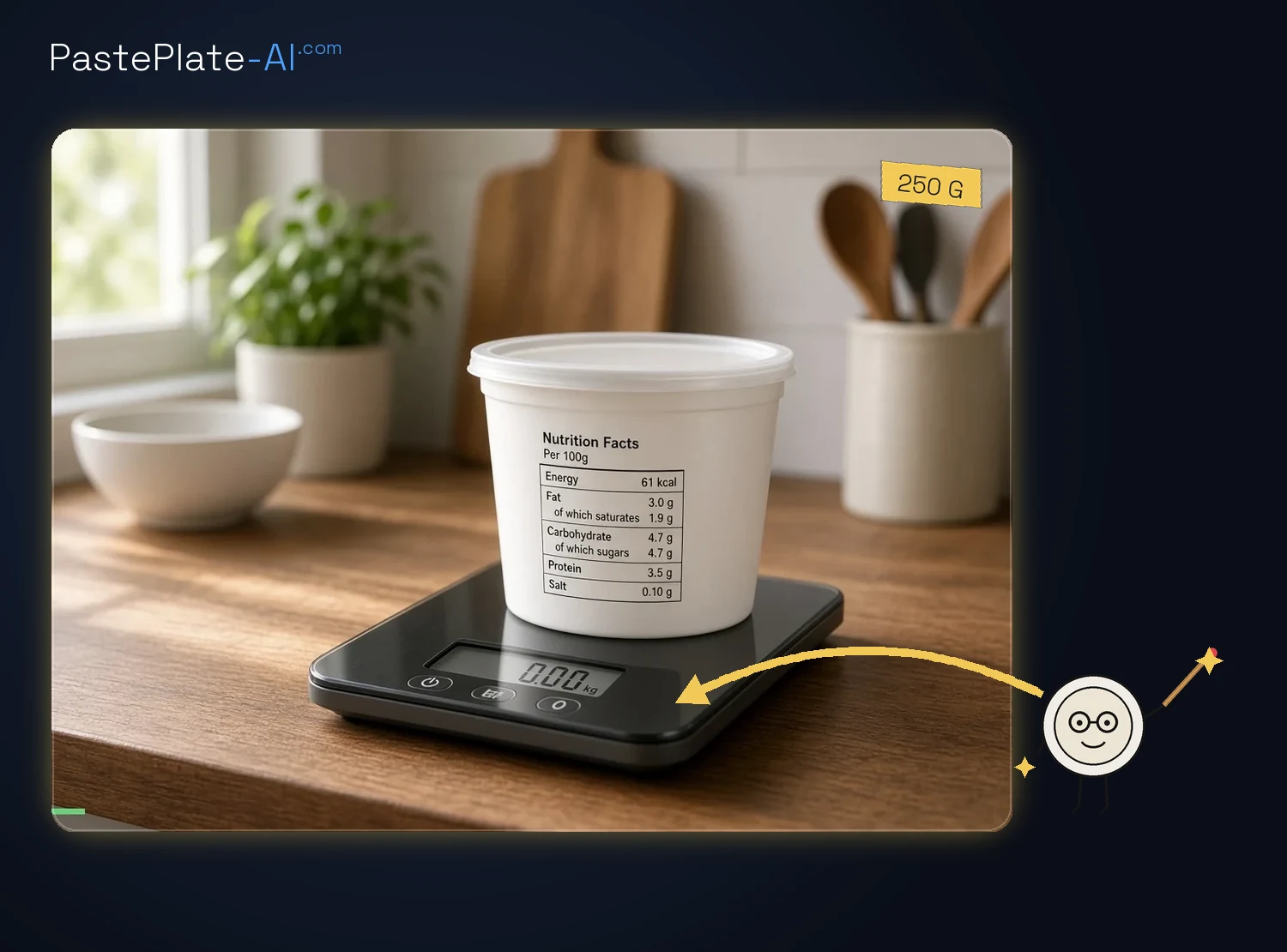
1. Greek yoghurt, 250 g bowl, 4 g protein per 100 g
(4 × 250) ÷ 100 = 10 g protein
2. Breakfast cereal, 45 g weighed
If the label says 8 g sugar per 100 g: (8 × 45) ÷ 100 = 3.6 g sugar
3. Orange juice, 200 ml (use per 100 ml)
If energy is 180 kJ per 100 ml: (180 × 200) ÷ 100 = 360 kJ for your glass
Same line works for calories, fat, fibre or salt; always check whether the column is per 100 g or per 100 ml.
Portions on the pack vs your real bowl
The "per portion" line is handy for a quick glance, but portions are defined by the manufacturer. Your pour, heap or slice can differ every day.
Weighing once (bowl empty, bowl full, subtract) gives a reusable gram count for that usual serving. Log the grams, not just "one bowl".
Make the sum visible, so you can check it
When you use an AI chat or calculator, ask it to write the multiplication out:
4 g/100 g × 250 g = 10 g protein
That way you spot wrong units (ml vs g) or a missed zero before it lands in your day total.
Try it yourself
Pick one packaged food today, find the per 100 g column, and scale it to what you ate. Try it free for 7 days.
Sources
- European Commission, "Nutrition labelling" (EU Reg. 1169/2011), accessed 20 October 2026. food.ec.europa.eu
Video transcript
This yoghurt says 4 g of protein. Per what? Labels often show values per 100 g, sometimes per portion, and your bowl is rarely exactly either. The label maths: value per 100 g times what you ate divided by 100. Four grams times 250 grams divided by 100 equals 10 grams protein. Ask your AI to show that sum, not just the answer.
PastePlate-AI on your phone
The logbook stays on your device. You bring the chat AI you already use.
This blog does not give medical advice. Health disclaimer.