Same calories offered, 500 more eaten: the ultra-processed food study explained
A 2019 clinic study asked a narrow question: if the food on offer is matched, do people still eat more when the menu is ultra-processed?
Short answer
- 20 adults lived at a research clinic and ate each menu for two weeks, as much as they wanted.
- Meals were matched on offer for calories, sugar, fat and fibre.
- On the ultra-processed menu they ate about 500 kcal a day more.
- A 2025 UK trial still found that processing mattered inside healthy-eating guidance. Both trials are small. This is not a diet plan.

The experiment in one paragraph
Hall and colleagues admitted 20 adults to a research clinic (Cell Metabolism, 2019). Each person ate an ultra-processed menu for two weeks and an unprocessed menu for two weeks, in random order. They could eat as much as they wanted. The clinic, not the supermarket, controlled what was available.
What "matched on offer" means
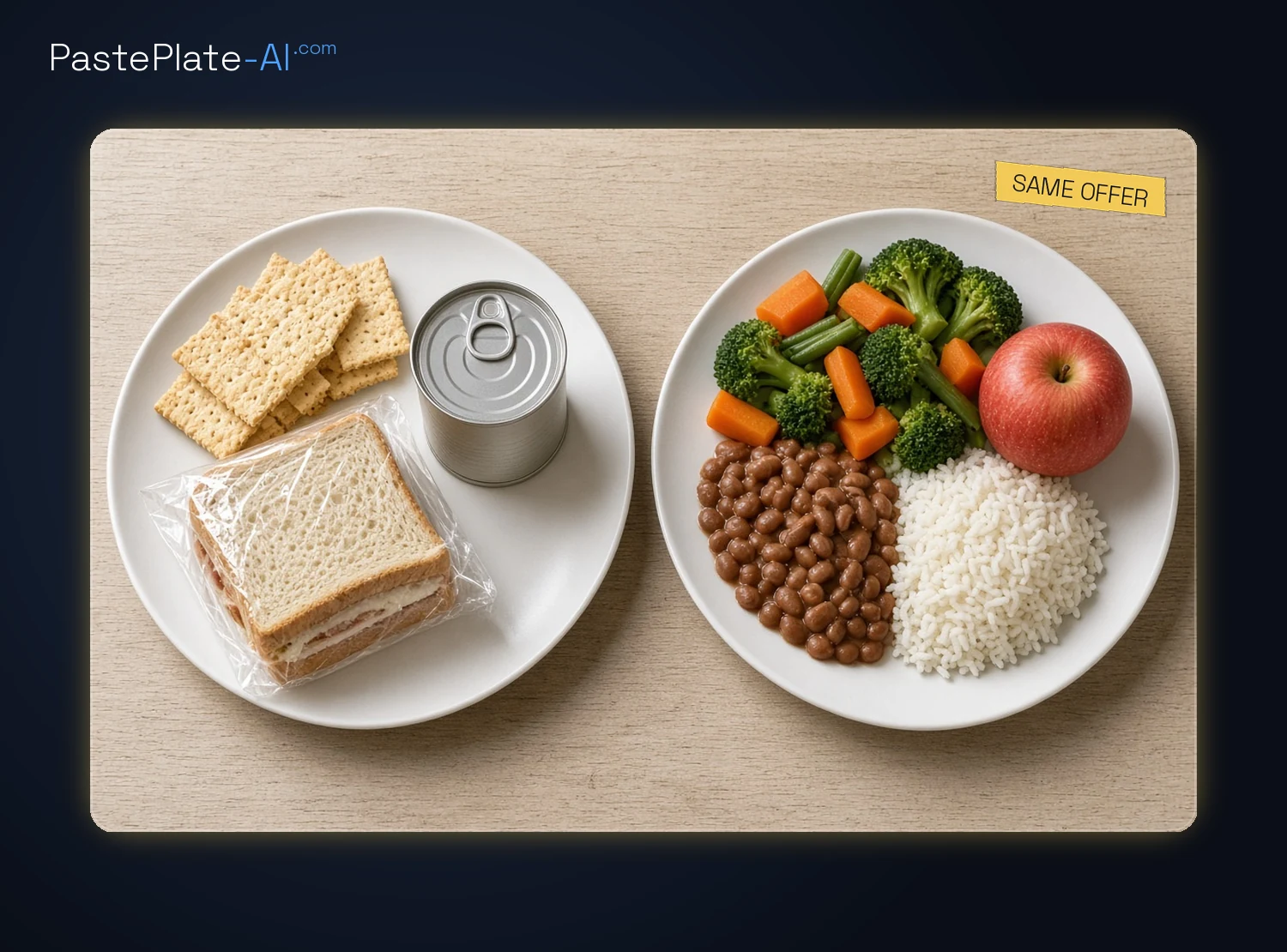
The two menus were built so that the calories, sugar, fat and fibre available were similar. That is not the same as what people finished. "Matched on offer" means the kitchen put comparable totals on the tray. It does not mean every bite was identical, or that anyone was told to clear the plate.

What they ate
On the ultra-processed menu, people ate about 500 kcal a day more than on the unprocessed menu. The study found that difference in a closed clinic, with food provided and little else to do. It is a result about intake in that setting, not a promise about any reader's week.
What the 2025 UK trial adds
Dicken and colleagues ran a randomised crossover trial in 55 adults (Nature Medicine, 2025). Each menu lasted eight weeks. Both the ultra-processed menu and the minimally processed menu were written to sit inside UK healthy-eating guidance. The trial still found that the level of processing mattered for what people ate and for the measurements the authors tracked. It does not turn a guideline into a personal target.
What "ultra-processed" means, briefly
Researchers often use the NOVA grouping. In that language, ultra-processed foods are industrial products made with ingredients and processes you would not use in a home kitchen: many packaged snacks, soft drinks and ready meals. The label is a sorting tool. It is not a moral grade, and two products in the same group can still differ.
A 2024 umbrella review in the BMJ (Lane et al.) linked higher ultra-processed intake with a range of poorer health outcomes in observational studies. Linked is not caused. Those papers did not lock people in a clinic and change one thing.
Limits, then one swap
The 2019 trial was small, short and inside a clinic. People were not living their normal week. The 2025 trial was longer and still a controlled feeding study, not a map of every kitchen.
You do not have to be perfect. Swapping one packaged meal a day for something simple is a start, not a rule.

This post is general information, not medical or dietary advice.
Sources
- Hall K. D. et al. (2019), inpatient randomised crossover trial of an ultra-processed versus an unprocessed menu, Cell Metabolism. PubMed
- Dicken S. J. et al. (2025), randomised crossover trial of ultra-processed and minimally processed menus within UK healthy-eating guidance, Nature Medicine. nature.com
- Lane M. M. et al. (2024), umbrella review of ultra-processed foods and health outcomes, BMJ. PubMed
Video transcript
Same calories on the plate. People still ate five hundred more a day.
In a 2019 lab study, twenty adults lived at a research clinic and ate either an ultra-processed or an unprocessed diet for two weeks each, as much as they wanted.
Meals were matched for calories, sugar, fat and fibre on offer. On the ultra-processed diet, they ate about five hundred calories a day more.
You don't have to be perfect. Swapping one packaged meal a day for something simple is a start.
PastePlate-AI on your phone
The logbook stays on your device. You bring the chat AI you already use.
This blog does not give medical advice. Health disclaimer.