A handful of nuts and 30 years of data: what the big studies found
Two famous cohorts followed nurses and other health professionals for about 30 years and asked how often they ate nuts. The headline number is easy to overread.
Short answer
- About 119,000 people, food questionnaires, roughly 30 years of follow-up.
- Nuts 7 or more times a week were linked to about 20% lower death rates than no nuts.
- Nut eaters also had other healthy habits. Part of the funding came from a nut industry council.
- A later meta-analysis of many cohorts points the same way. None of this is an instruction to eat nuts so you live longer.

Who was followed, and how
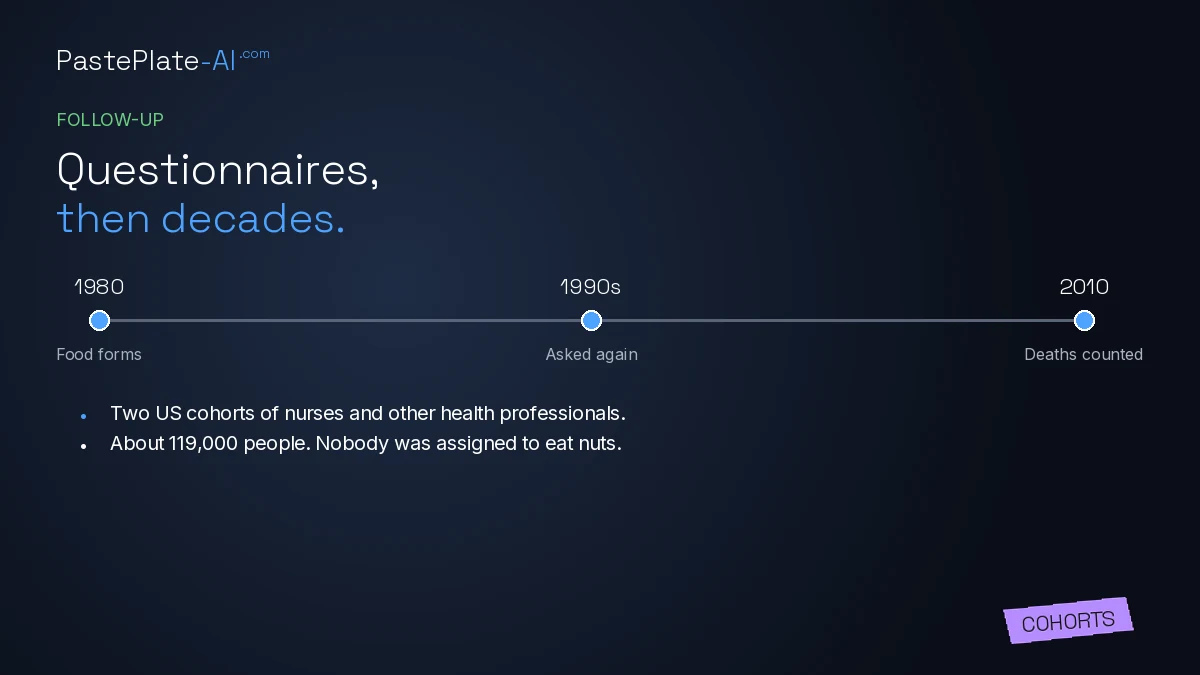
Bao and colleagues published the analysis in the New England Journal of Medicine (2013). They used the Nurses' Health Study and the Health Professionals Follow-up Study. People filled in food questionnaires every few years. Researchers then counted deaths over about three decades. Nobody was assigned to a nut diet. The studies recorded what people said they already ate.
What the numbers say, and what they do not
Eating nuts more often was linked to lower death rates. Seven or more times a week was linked to about 20% lower mortality than never eating nuts. "Linked" means the two things travelled together in the data. It does not mean the nuts caused the difference.
People who ate nuts also tended to smoke less, move more and eat other foods that researchers already associate with better health. Statisticians can adjust for some of that. They cannot see every habit that was never written down.
Who paid, and what a wider pool adds
Part of the funding for the 2013 paper came from the International Tree Nut Council Nutrition Research and Education Foundation. That does not erase the data. It does belong in the same paragraph as the result, because a funder with a stake in nuts is not a neutral bystander.
Aune and colleagues pooled many cohort studies in BMC Medicine (2016). The pooled picture also linked higher nut intake with lower death rates. Pooling does not turn questionnaires into an experiment. It makes the same kind of observation in more than one population.

Limits
Self-reported food is fuzzy. The cohorts are mostly US health professionals, not a random sample of the world. Deaths have many causes. A handful of nuts can be a pleasant food. These papers do not show that nuts are a longevity treatment.

This post is general information, not medical or dietary advice.
Sources
- Bao Y. et al. (2013), "Association of nut consumption with total and cause-specific mortality", New England Journal of Medicine. PubMed
- Aune D. et al. (2016), nut consumption and risk of cardiovascular disease, total cancer, and all-cause mortality, BMC Medicine. bmcmedicine
Video transcript
Nuts, and thirty years of follow-up in a hundred and nineteen thousand people.
Two long-running studies of US nurses and other health professionals asked how often people ate nuts.
Eating nuts more often was linked to lower death rates. Seven or more times a week was linked to twenty percent lower mortality than no nuts.
Nut eaters also had other healthy habits, and the study was partly funded by a nut industry council.
PastePlate-AI on your phone
The logbook stays on your device. You bring the chat AI you already use.
This blog does not give medical advice. Health disclaimer.